Google+

Sunday, May 18, 2014

Proof without words (Sum of odd numbers)

In mathematics, a proof without words is a proof of an identity or mathematical statement which can be demonstrated as self-evident by a diagram without any accompanying explanatory text. Such proofs can be considered more elegant than more formal and mathematically rigorous proofs due to their self-evident nature. When the diagram demonstrates a particular case of a general statement, to be a proof, it must be able to be generalised.

Sum of odd numbers

The statement that the sum of all positive odd numbers up to 2n − 1 is a perfect square—more specifically, the perfect square n2—can be demonstrated by a proof without words, as shown below. The first square is formed by 1 block; 1 is the first square. The next strip, made of white squares, shows how adding 3 more blocks makes another square: four. The next strip, made of black squares, shows how adding 5 more blocks makes the next square. This process can continue indefinitely.


Tuesday, April 30, 2013

Unexpected hanging paradox


The unexpected hanging paradox, hangman paradox, unexpected exam paradox, surprise test paradox or prediction paradox is a paradox about a person's expectations about the timing of a future event (e.g. a prisoner's hanging, or a school test) which he is told will occur at an unexpected time.
Despite significant academic interest, there is no consensus on its precise nature and consequently a final 'correct' resolution has not yet been established. One approach, offered by the logical school of thought, suggests that the problem arises in a self-contradictory self-referencing statement at the heart of the judge's sentence. Another approach, offered by the epistemological school of thought, suggests the unexpected hanging paradox is an example of an epistemic paradox because it turns on our concept of knowledge. Even though it is apparently simple, the paradox's underlying complexities have even led to it being called a "significant problem" for philosophy.

Monday, February 11, 2013

New prime number: The biggest ever found


The record for biggest prime number ever discovered has been shattered again. The latest holder of the title has 17,425,170 digits — over four million more than the previous "biggest" prime number, discovered in 2008, says a news release from the Great Internet Mersenne Prime Search (GIMPS), the distributed computing project that found it.
This is the beginning of the new record-setting prime number, which continues for more than 17 million more digits. (GIMPS)

Tuesday, January 29, 2013

Fermat's little theorem


Fermat's little theorem states that if p is a prime number, then for any integer a, the number a p − a is an integer multiple of p. In the notation of modular arithmetic, this is expressed as
a^p \equiv a \pmod p.
For example, if a = 2 and p = 7, 27 = 128, and 128 − 2 = 7 × 18 is an integer multiple of 7.
If a is not divisible by p, Fermat's little theorem is equivalent to the statement that a p − 1 − 1 is an integer multiple of p:
a^{p-1} \equiv 1 \pmod p.
For example, if a = 2 and p = 7, 26 = 64, and 64 − 1 = 63 = 7 × 9.
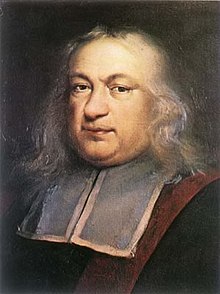
Fermat's little theorem is the basis for the Fermat primality test and is one of the fundamental results of elementary number theory. The theorem is named after Pierre de Fermat, who stated it in 1640. It is called the "little theorem" to distinguish it from Fermat's last theorem.

Sunday, December 9, 2012

Mathematics of planet earth 2013


Dozens of scientific societies, universities, research institutes, and foundations all over the world have banded together to dedicate 2013 as a special year for the Mathematics of Planet Earth.
Our planet is the setting for dynamic processes of all sorts, including the geophysical processes in the mantle, the continents, and the oceans, the atmospheric processes that determine our weather and climates, the biological processes involving living species and their interactions, and the human processes of finance, agriculture, water, transportation, and energy. The challenges facing our planet and our civilization are multidisciplinary and multifaceted, and the mathematical sciences play a central role in the scientific effort to understand and to deal with these challenges.

Friday, November 23, 2012

The Birthday Problem


In probability theory, the birthday problem or birthday paradox concerns the probability that, in a set of n randomly chosen people, some pair of them will have the same birthday. By the pigeonhole principle, the probability reaches 100% when the number of people reaches 367 (since there are 366 possible birthdays, including February 29). However, 99% probability is reached with just 57 people, and 50% probability with 23 people. These conclusions are based on the assumption that each day of the year (except February 29) is equally probable for a birthday.
The mathematics behind this problem led to a well-known cryptographic attack called the birthday attack, which uses this probabilistic model to reduce the complexity of cracking a hash function.

Wednesday, November 21, 2012

√2 is irrational

Theorem: The square root of 2 is irrational,  \sqrt{2} \notin \mathbb{Q}

Proof

Assume for the sake of contradiction that  \sqrt{2} \in \mathbb{Q} . Hence  \sqrt{2} = \frac{a}{b}  holds for some a and b that are coprime.
This implies that 2 = \frac{a^2}{b^2}. Rewriting this gives 2b^2 = a^2 \!\,.
Since the left-hand side of the equation is divisible by 2, then so must the right-hand side, i.e., 2 | a^2 . Since 2 is prime, we must have that 2 | a .
So we may substitute a with 2a', and we have that 2b^2 = 4a^2 \!\,.
Dividing both sides with 2 yields b^2 = 2a^2 \!\,, and using similar arguments as above, we conclude that 2 | b . However, we assumed that  \sqrt{2} = \frac{a}{b}  such that that a and b were coprime, and have now found that 2 | a  and 2 | b ; a contradiction.
Therefore, the assumption was false, and  \sqrt{2}  cannot be written as a rational number. Hence, it is irrational.

Friday, November 2, 2012

Law of total variance


In probability theory, the law of total variance or variance decomposition formula, also known by the acronym EVVE (or Eve's law for short), states that if X and Y are random variables on the same probability space, and the variance of Y is finite, then
\operatorname{var}(Y)=\operatorname{E}(\operatorname{var}(Y\mid X))+\operatorname{var}(\operatorname{E}(Y\mid X)).\,
In language perhaps better known to statisticians than to probabilists, the two terms are the "unexplained" and the "explained component of the variance"
The nomenclature in this article's title parallels the phrase law of total probability. Some writers on probability call this the "conditional variance formula" or use other names.
Note that the conditional expected value E( Y | X ) is a random variable in its own right, whose value depends on the value of X. Notice that the conditional expected value of Y given the event X = y is a function of y (this is where adherence to the conventional rigidly case-sensitive notation of probability theory becomes important!). If we write E( Y | X = y ) = g(y) then the random variable E( Y | X ) is just g(X). Similar comments apply to the conditional variance.

Friday, October 26, 2012

Apparent Paradox

  1.  Exactly one of these statements is false.
  2. Exactly two of these statements are false.
  3. Exactly three of these statements are false.
  4. Exactly four of these statements are false.
  5. Exactly five of these statements are false.
  6. Exactly six of these statements are false.
  7. Exactly seven of these statements are false.
  8. Exactly eight of these statements are false.
  9. Exactly nine of these statements are false
  10. Exactly ten of these statements are false. 
How many of them are true?If any , which ones?


Thursday, October 25, 2012

Mathematics and Reality


The question is sometimes raised as to how it is that mathematics, which is a creation of the human mind, without any empirical reference to external reality, should match reality so well. When we make the distinction between the reality we experience and the underlying reality, the correlation between mathematics and reality is not so surprising.
Science takes our observations of the external world and seeks to understand how they occur and to discover underlying patterns and principles. In doing so, it inevitably draws upon experience When atoms were first imagined, they were thought of as small solid balls of matterÑa model clearly drawn from everyday experience. Then, as physics realized that atoms were composed of more elementary particles (even the word "particle" contains an implicit assumption as to their nature), the model shifted to one of a central nucleus surrounded by orbiting electronsÑagain based on experience at the human level. Now, as we try to interpret quantum theory, we inevitably draw upon other concepts derived from our perception of reality. We interpret them as waves or bundles of energy, possessing "spin" and mass. Yet every model we come up with, fails in some way or another to capture the essence of the underlying reality.

Monday, October 22, 2012

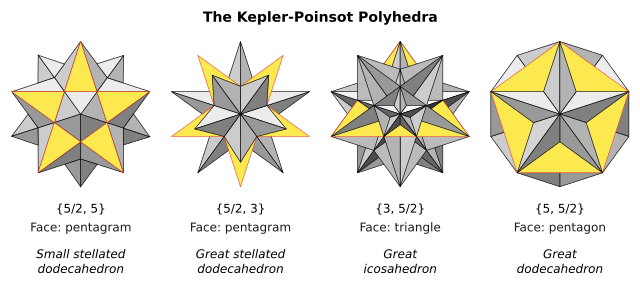
Kepler–Poinsot polyhedra

In geometry, a Kepler–Poinsot polyhedron is any of four regular star polyhedra. They may be obtained by stellating the regular convex dodecahedron and icosahedron, and differ from these in having regular pentagrammic faces or vertex figures.


The four Kepler–Poinsot polyhedra are illustrated above. Each is identified by its Schläfli symbol, of the form {p, q}, and by its name. One face of each figure is shown yellow and outlined in red.


Sunday, October 21, 2012

Descartes' rule of signs


In mathematics, Descartes' rule of signs, first described by René Descartes in his work La Géométrie, is a technique for determining the number of positive or negative real roots of a polynomial.
The rule gives us an upper bound number of positive or negative roots of a polynomial. It is not a complete criterion, i.e. it does not tell the exact number of positive or negative roots.

Saturday, October 6, 2012

Polarization identity


In mathematics, the polarization identity is any one of a family of formulas that express the inner product of two vectors in terms of the norm of a normed vector space. Let \|x\| \, denote the norm of vector x and \langle x, \ y \rangle \, the inner product of vectors x and y. Then the underlying theorem, attributed to Fréchet, von Neumann and Jordan, is stated as:
In a normed space (V, \| \cdot \|), if the parallelogram law holds, then there is an inner product on V such that \|x\|^2 = \langle x,\ x\rangle for all x \in V.


Tuesday, September 11, 2012

The Pirate Game

The pirate game is a simple mathematical game. It illustrates how, if assumptions conforming to a homo economicus model of human behaviour hold, outcomes may be surprising. It is a multi-player version of the ultimatum game.

The Game

There are 5 rational pirates, A, B, C, D and E. They find 100 gold coins. They must decide how to distribute them.
The pirates have a strict order of seniority: A is superior to B, who is superior to C, who is superior to D, who is superior to E.
The pirate world's rules of distribution are thus: that the most senior pirate should propose a distribution of coins. The pirates, including the proposer, then vote on whether to accept this distribution. If the proposed allocation is approved by a majority or a tie vote, it happens. If not, the proposer is thrown overboard from the pirate ship and dies, and the next most senior pirate makes a new proposal to begin the system again.
Pirates base their decisions on three factors. First of all, each pirate wants to survive. Second, given survival, each pirate wants to maximize the number of gold coins he receives. Third, each pirate would prefer to throw another overboard, if all other results would otherwise be equal. The pirates do not trust each other, and will neither make nor honor any promises between pirates apart from the main proposal.

Sunday, August 26, 2012

Cauchy Sequences


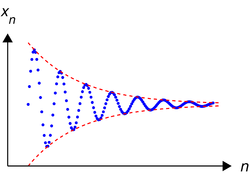
In mathematics, a Cauchy sequence , named after Augustin-Louis Cauchy, is a sequence whose elements become arbitrarily close to each otheras the sequence progresses. More precisely, given any small positive distance, all but a finite number of elements of the sequence are less than that given distance from each other.
The utility of Cauchy sequences lies in the fact that in a complete metric space (one where all such sequences are known to converge to a limit), the criterion for convergence depends only on the terms of the sequence itself. This is often exploited in algorithms, both theoretical and applied, where an iterative process can be shown relatively easily to produce a Cauchy sequence, consisting of the iterates.
The notions above are not as unfamiliar as they might at first appear. The customary acceptance of the fact that any real number x has a decimal expansion is an implicit acknowledgment that a particular Cauchy sequence of rational numbers (whose terms are the successive truncations of the decimal expansion of x) has the real limit x. In some cases it may be difficult to describe x independently of such a limiting process involving rational numbers.
Generalizations of Cauchy sequences in more abstract uniform spaces exist in the form of Cauchy filter and Cauchy net.

Sunday, July 8, 2012

How to diagonalize a matrix


Consider a matrix
A=\begin{bmatrix}
1 & 2  & 0 \\
0 & 3  & 0 \\
2 & -4 & 2 \end{bmatrix}.
This matrix has eigenvalues
 \lambda_1 = 3, \quad \lambda_2 = 2, \quad \lambda_3= 1.
So A is a 3-by-3 matrix with 3 different eigenvalues, therefore it is diagonalizable. Note that if there are exactly n distinct eigenvalues in an n×n matrix then this matrix is diagonalizable.
These eigenvalues are the values that will appear in the diagonalized form of matrix A, so by finding the eigenvalues of A we have diagonalized it. We could stop here, but it is a good check to use the eigenvectors to diagonalize A.

Saturday, July 7, 2012

Identity Theorem


In complex analysis, a branch of mathematics, the identity theorem for holomorphic functions states: given functions f and g holomorphic on a connected open set D, if f = g on some neighborhood of z that is in D, then f = g on D. Thus a holomorphic function is completely determined by its values on a (possibly quite small) neighborhood in D. This is not true for real-differentiable functions. In comparison, holomorphy, or complex-differentiability, is a much more rigid notion. Informally, one sometimes summarizes the theorem by saying holomorphic functions are "hard" (as opposed to, say, continuous functions which are "soft").
The underpinning fact from which the theorem is established is the developability of a holomorphic function into its Taylor series.

Proof

The connectedness assumption on the domain D is necessary and is in fact key to a short proof given here (obviously, if D consists of two disjoint open sets, the result does not hold). Under this assumption, since we are given that the set is not empty, topologically the claim amounts to that f and g coincide on a set that is both open and closed.
The closedness is immediate from the continuity of f and g.
Therefore, the main issue is to show that the set on which f = g is an open set.
Because a holomorphic function can be represented by its Taylor series everywhere on its domain, it is sufficient to consider the set
S = \{ z \in D \; | \; f^{(k)}(z) = g^{(k)}(z) \quad \mbox{for all} \; k  \geq 0\}.
Suppose w lies in S. Then, because the Taylor series of f and g at w have non-zero radius of convergence, the open disk Br(w) also lies in S for some r. (In fact, r can be anything less than the distance from w to the boundary of D). This shows S is open and proves the theorem.